
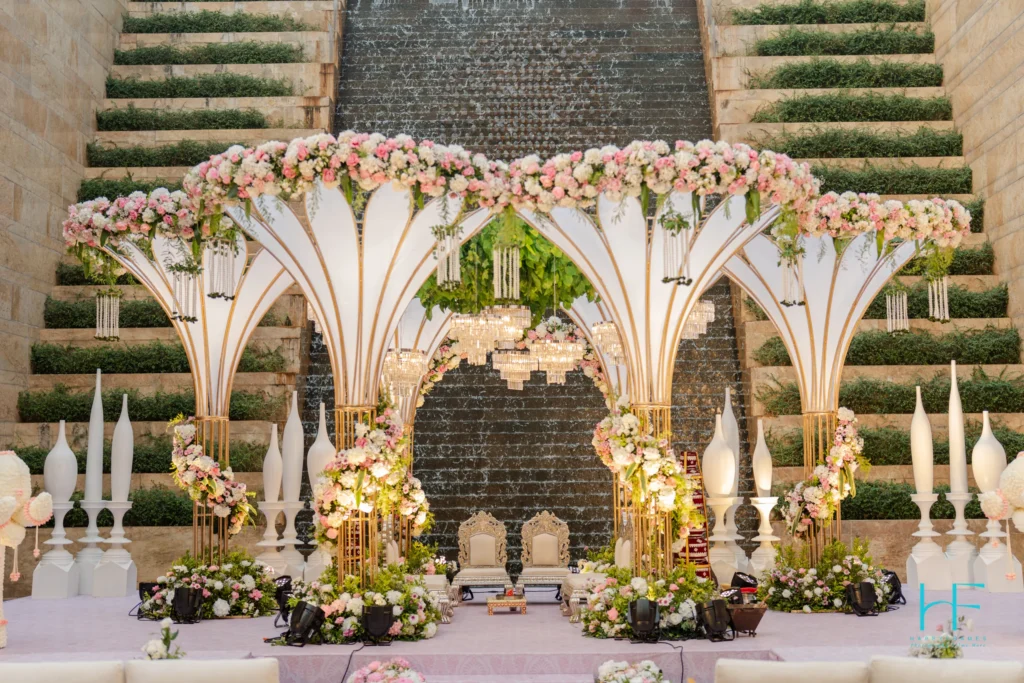
Most couples walk into a venue looking for one feeling: “Can I see myself getting married here?”
That matters. But in destination wedding planning, the site visit has a second job that’s even more important: it tells you whether the wedding can run smoothly in that space, with your guest count, your rituals, your timelines, and your vendors.
Because a venue can be stunning and still create problems you only notice when it’s too late. A mandap that looks beautiful but blocks sightlines. An entry route that turns into a bottleneck. A ballroom that photographs flat because the lighting can’t be controlled. A terrace that feels dreamy until you realise there’s limited power or strict sound rules. A hotel that promises flexibility, but has tight setup windows.
This is why seasoned planners don’t “visit.” They inspect. Calmly. Properly. Without panic.
At The Wedding Trunk (established in 2017, planning across India and the UAE), we plan weddings end-to-end from “they said yes” to “thank you for coming,” including venue selection, budget mapping, vendor management, RSVP systems, hospitality desks, logistics planning, and on-ground show-running. If you’d like us to shortlist venues and run a practical site visit with you, visit www.theweddingtrunk.com or call India: +91 98925 99799 or UAE: +971 56 934 3443.
A quick, simple note on venue recce and why it saves weddings
A venue recce is when you go to the location in advance to check everything properly, instead of assuming it will work on the day. For a wedding, venue recce includes checking the space layout (stage, seating, entry and exit), understanding lighting and decor possibilities, looking at power supply, sound setup and AC, planning camera angles and photography spots, identifying guest flow and parking, and spotting any problems in advance. In simple terms, recce is how you plan smoothly and avoid last-minute issues guests can feel immediately.
Before you go: what to prepare so the visit is actually useful
A venue site visit becomes ten times more productive when you walk in with the right inputs.
Bring this with you:
- Your approximate guest count range (not final names, just a realistic band)
- Your event list (welcome, mehendi, haldi, sangeet, ceremony, reception)
- Your non-negotiables (baraat, pheras setup, Nikah timing, any specific ritual needs)
- A rough budget range, even if it’s early
- A short “guest reality” note: elders, kids, overseas guests, mobility needs
If you want a clean, budget-first way to shortlist venues before you spend weekends visiting everything, that’s exactly where an end-to-end planning team helps. You can start with us at www.theweddingtrunk.com.
1) The space check that matters most: can everyone see and move comfortably?
This is the part couples often miss because they’re looking at decor potential. You need to look at human flow.
Ask and check:
- Where will the ceremony focal point sit (mandap or stage)?
- From the back rows, can guests see faces, not just heads?
- Where will elders sit, and can they see clearly without struggling?
- Are there pillars, low ceilings, or awkward angles that block sightlines?
- Can guests move without squeezing past tables or crowding the aisle?
Quick test: stand at three points. Front, middle, back. If you feel disconnected from the centre at any of those points, guests will too.
2) Entry and exit routes: where weddings quietly get messy
Guests remember confusion. Not because they complain, but because it changes the mood.
Walk the routes:
- Guest arrival drop-off to venue entrance
- Entrance to seating
- Seating to washrooms
- Seating to food counters
- Exit route at the end of the night
Then ask:
- Do we have one clear entrance, or multiple entry points that will confuse guests?
- Is there a dedicated VIP and elder-friendly entry?
- Can late arrivals enter without interrupting key moments?
If your wedding is in a hotel, ask which areas are public-facing and how privacy is managed. A calm entry is part of premium hosting.
3) Lighting reality: don’t guess, test it
Lighting is the difference between “pretty” and “premium” in photos. And it changes dramatically by time of day.
Check:
- What does the venue look like at your likely ceremony time?
- If outdoors, where does harsh sun land? Where is shade?
- If indoors, does the room rely on cold downlights?
- Can lighting be controlled or adjusted for face light?
- Is there a plan for sunset shifts if you’re transitioning from day to evening?
Don’t be shy about taking quick phone videos from different angles. You’ll learn more from that than from any brochure.
If you want your venue choice guided by photography and guest comfort, not only aesthetics, call UAE: +971 56 934 3443.
4) Power, sound, and AC: the unglamorous checks that prevent chaos
This is where weddings lose time on the day because something “unexpected” happens. Usually, it wasn’t unexpected. It was just never checked.
Ask the venue:
- Where are the power points and what is the load capacity?
- Are there restrictions on external production?
- What are the sound rules and cutoff times?
- Where can DJs and consoles be placed without blocking guest movement?
- How strong is the AC and can zones be controlled?
In the UAE, sound and venue policies can be strict. In India, outdoor spaces can look expansive but still have limited power access. Either way, if your production team cannot execute cleanly, the night suffers.
5) Vendor logistics: can the venue handle a wedding build properly?
In destination wedding planning, execution depends on vendor access. A venue can be gorgeous and still be a nightmare to build in.
Confirm:
- Vendor load-in route and timing windows
- Where trucks can park and unload
- Whether service elevators are available and large enough
- Setup and teardown time rules per function
- Storage space for props, florals, or spare equipment
Ask one direct question: “If we finish setup early, can the room be fully closed until doors open?”
That single detail affects how premium the guest’s arrival feels.
6) Food service flow: where queues form and energy drops
Food is not only about the menu. It’s about how fast and clean service can happen.
Walk the service plan:
- Where would buffet counters sit without creating bottlenecks?
- Can staff circulate easily without colliding with guest flow?
- Is there space for dietary lanes (Jain, allergies, mild spice) without looking like an afterthought?
- Where will water points be placed so guests aren’t constantly walking through key areas?
If you’re hosting 150+ guests, your venue needs multiple service points. Otherwise, guests spend half the evening standing in lines, and that affects the mood more than people realise.
7) Where will the couple breathe?
Couples need a calm holding space. Not a makeshift corner.
Check:
- Is there a private holding room close to the entry?
- Is it comfortable for outfit changes and touch-ups?
- Is there a clean route from holding to stage or mandap without crossing guest paths?
- Is there a space for family members who need quiet moments during emotional sections?
This is one of the most “luxury” parts of planning, even though guests never see it. The couple feels it all day.
If you want couple protection and smooth backstage movement built into your plan, call India: +91 98925 99799.
8) The questions couples forget to ask before signing
Before you leave the visit, confirm these clearly:
- What is included in the venue package and what is charged extra?
- Are there mandatory vendors or restrictions on external vendors?
- What is the exact time window for each function space?
- What is the rain plan and how fast can the switch happen?
- What are the sound policies and end times?
- What is the deposit, cancellation, and reschedule policy?
- Who is the on-ground venue point of contact during the wedding days?
If answers feel vague, the wedding will feel vague later. Clarity now saves stress later.
Copy-ready venue site visit checklist
Use this on every venue visit:
Space and visibility
- Sightlines tested from front, middle, and back
- Mandap or stage placement feasibility confirmed
- Elder seating visibility and comfort checked
Entry, exits, and guest flow
- Drop-off to entrance route walked
- Guest entrance and late-entry plan possible
- Washrooms and food access routes checked
Lighting and photo reality
- Lighting tested at your likely event time
- Outdoor sun and shade mapped
- Indoor lighting control options confirmed
Technical
- Power points and load capacity confirmed
- Sound rules, cutoff times, and restrictions confirmed
- AC zones and comfort reality checked
Vendor operations
- Load-in route, parking, and service access confirmed
- Setup and teardown windows confirmed
- Storage space and back-of-house areas identified
Food service
- Counter placement avoids bottlenecks
- Staff movement routes make sense
- Dietary lanes can be handled cleanly
Backstage
- Couple holding space confirmed
- Outfit change and touch-up space workable
- Private movement routes possible
Contract clarity
- Inclusions and exclusions written clearly
- Rain plan and indoor alternative confirmed
- Venue point-of-contact and escalation path confirmed
A venue site visit should reduce your anxiety, not add to it.
When you walk into a venue with the right checklist, you stop choosing based only on beauty and start choosing based on how the wedding will actually run. That is what makes destination wedding planning feel smooth. Guests feel guided. Vendors execute cleanly. The couple stays present. And the celebration feels premium from the inside.If you’d like The Wedding Trunk to shortlist venues, run the venue recce with you, and build your plan end-to-end across India and the UAE, we’re here: www.theweddingtrunk.com | India: +91 98925 99799 | UAE: +971 56 934 3443.