
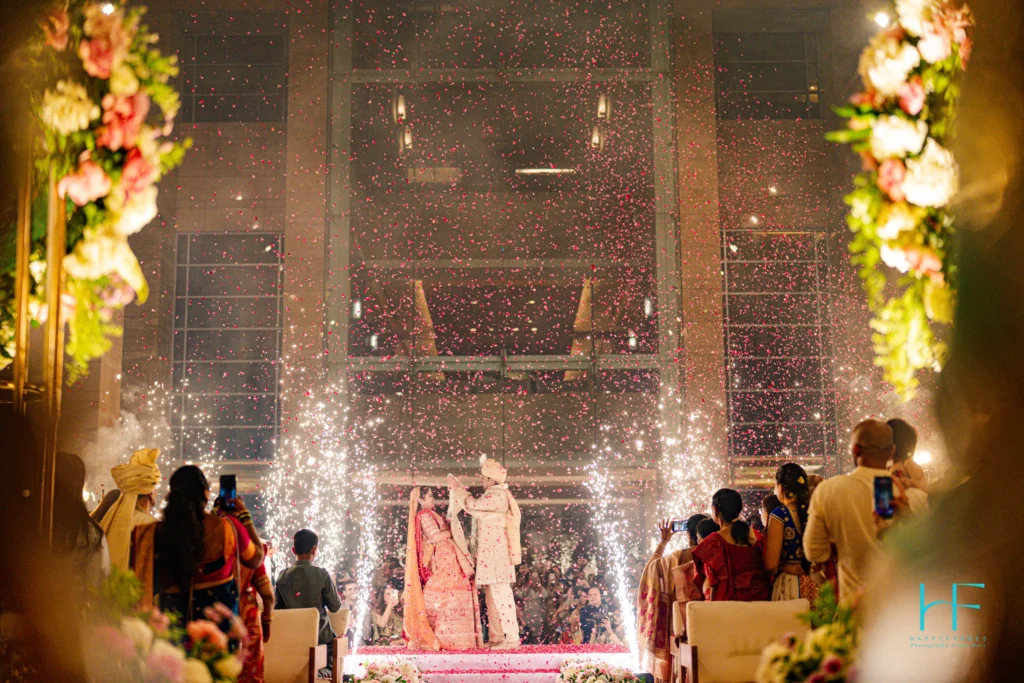
Most couples think photography should “fit into” the wedding day.
In reality, your wedding day already has photography built into it. Every entry, ritual, blessing, speech, and reaction is a photo moment. The only question is whether those moments happen in good light, with calm faces, and in a room that looks finished, or whether they happen while people are still walking in, the mic is being adjusted, and the couple is being pulled into last-minute decisions.
This is one of the quiet skills of luxury event management. Not forcing the day to look like a photoshoot, but designing the day so photography happens naturally, beautifully, and without stress.
At The Wedding Trunk (established in 2017, planning across India and the UAE), we plan weddings end-to-end from “they said yes” to “thank you for coming,” including venue planning, vendor management, show-running, and on-ground execution. If you want your wedding timeline built in a way that protects both the experience and the photos, visit www.theweddingtrunk.com or call India: +91 98925 99799 or UAE: +971 56 934 3443.
A short, simple note on venue recce and why it protects your photos
A venue recce is when you go to the location in advance to check everything properly, instead of assuming it will work on the day. For a wedding, venue recce includes checking the space layout (stage, seating, entry and exit), understanding lighting and decor possibilities, looking at power supply, sound setup and AC, planning camera angles and photography spots, identifying guest flow and parking, and spotting any problems in advance. In simple terms, recce is a pre-visit to plan smoothly and avoid last-minute issues. For photography, it matters because you can lock the best portrait corners, understand harsh sun or indoor lighting reality, plan clean camera lanes, and avoid backgrounds that look messy on camera.
The biggest timeline mistake couples make
They build the day around event start times, then try to squeeze photos into whatever gaps remain.
That usually creates three problems:
- Portraits are rushed, or pushed into the wrong light
- Guests wait while the couple disappears for photos at awkward times
- The couple looks tense because they are constantly catching up
A better approach is to build the timeline around “photo-ready moments.” Not longer photos. Better-timed photos.
Step 1: Decide your photo priorities before you decide timings
You do not need a thousand photos. You need the right photos, captured in calm windows.
Before you plan a single time slot, decide:
- Do you want more editorial couple portraits, or more candid family moments?
- Are sunrise or golden-hour portraits important to you?
- Do you want a quiet first look, or do you prefer the first reveal at the ceremony?
- Do you want family portraits done in one focused block, or spread across the day?
This helps your planner and photographer build a realistic plan. Because luxury event management is not about adding moments. It is about editing the day so the right moments land cleanly.
If you want help mapping photo priorities into a realistic schedule, speak to our team at www.theweddingtrunk.com.
Step 2: Build the day around three photo anchors
Most wedding days run smoothly when these three anchors are protected.
Anchor 1: The calm preparation window
This is where detailed photos, family interactions, and quiet emotion happen. It is also where timelines often slip.
Protect it by planning:
- a fixed “ready by” time with buffer
- a clear hair and makeup schedule with realistic slots
- a no interruptions rule for the couple during final touches
This is where trained shadows or a planner assistant makes a real difference. The couple stays focused, and the room stays calm.
Anchor 2: The best light window
This can be golden hour, morning softness, or controlled indoor lighting. The point is not the time of day. The point is choosing one window and protecting it.
Protect it by planning:
- a dedicated portrait block of 20 to 35 minutes
- a nearby location that does not require travel or long walking routes
- a backup indoor portrait spot if weather shifts
Anchor 3: The room finished window
Photos look expensive when the room looks finished. If guests arrive while vendors are still fixing details, your photos will carry that chaos.
Protect it by planning:
- decor handover time (decor finishes and exits)
- production lock time (sound, lighting, screens tested)
- doors open time (guests enter only after readiness checks)
This is pure luxury event management. Guests never see setup. They only see the finished experience.
Step 3: Stop placing portraits in the middle of guest attention
A common mistake is scheduling portraits right when guests need the couple most.
Examples that create frustration:
- portraits right before dinner opens
- portraits immediately after the ceremony while guests are waiting with no direction
- portraits during the first 20 minutes of a reception when guests are seated and watching the stage
A better approach is to place portraits in “low-attention” windows:
- during the first dining wave when guests are eating
- during a performance block that does not require the couple on stage
- between events, with a planned activity for guests (tea, grazing, lounge time)
This is how you get beautiful photos without creating dead time.
If you want a run-of-show that keeps guests engaged while photo windows happen, call UAE: +971 56 934 3443.
Step 4: Family portraits need a system, not goodwill
Family portraits are where time disappears.
Not because families are slow. Because nobody knows who is next, where to stand, or when to come.
A clean system includes:
- one family portrait list, finalised before the day
- grouping logic (parents, siblings, grandparents, then extended family)
- one coordinator calling names and assembling people
- a fixed location with good light and clean background
- a hard time cap, usually 25 to 45 minutes depending on size
This is also where RSVP and guest list management helps. If you know who is attending which function, you do not chase people who are not even there.
If you want family portraits managed calmly without pulling the couple into coordination, reach us at www.theweddingtrunk.com.
Step 5: Ritual timelines should be built for photography and dignity
Rituals are not a performance. They are meaningful moments. They should never feel rushed, but they also should not drift so much that guests lose focus and the couple loses energy.
A strong timeline includes:
- realistic ritual durations with priest alignment
- clear sequencing for when key family members are needed
- sound planning so mantras and instructions are audible
- photography positions planned so cameras do not block sightlines
This is where ritual management meets production planning. When the mic is clear and the mandap is positioned properly, your ceremony photos look calm and dignified.
If your wedding includes a baraat, also plan the transition. The baraat can be high energy and the ceremony can still begin serene, if the seating and entry flow are designed properly.
Step 6: Lighting and sound are part of the photography timeline
Many couples treat lighting and sound as separate vendor tasks. They are not. They are photo quality.
A good timeline protects:
- sound check windows before guests enter
- mic tests for speech clarity, not just music
- lighting focus for faces, not only stage drama
- a clean party-shift cue where lighting changes with intention
In both India and the UAE, this matters because venues can be bright outdoors, cold indoors, or technically complex in ballrooms. If lighting is not planned, faces look tired and flat even in expensive decor.
If you want a production plan built into your run sheet so photos stay premium all night, call India: +91 98925 99799 or UAE: +971 56 934 3443.
Step 7: Use a photo-first “buffer rule” so the couple looks calm
Couples look their best when they are not sprinting.
A photo-first buffer rule includes:
- 10 minutes buffer before every major entry
- 5 minutes buffer after every major ritual block
- a private reset window for water, touch-up, and breath
- a backup plan for delays so you do not compress everything into portraits
When delays happen, luxury event management is not rushing. It is adjusting the day without showing stress. The couple stays present, and that presence photographs beautifully.
Copy-ready checklist: a photo-first wedding day timeline
- Venue recce completed to confirm light, best photo spots, and clean backgrounds
- Three anchors protected: preparation calm, best light, room finished
- Portraits placed in low-attention windows, not during peak guest waiting
- Family portraits run with a list, a coordinator, and one fixed location
- Ritual timing built with dignity and realistic durations, with sound clarity planned
- Lighting and sound checks protected before doors open
- Decor and production handovers set so guests never see setup in frames
- Buffers added before entries and after rituals so faces stay calm
- One showrunner owns timing calls, vendors do not call the couple on the day
The best wedding photos do not come from perfect poses. They come from a day that feels under control.
When your timeline is designed around photography, your portraits happen in the right light, your key moments happen in a finished space, and your faces look calm because you are not being pulled into logistics. That is what luxury event management delivers: a wedding that looks premium because it was run properly.
If you want The Wedding Trunk to build your wedding day timeline with a photo-first, guest-comfort approach across India and the UAE, we are here: www.theweddingtrunk.com | India: +91 98925 99799 | UAE: +971 56 934 3443.