
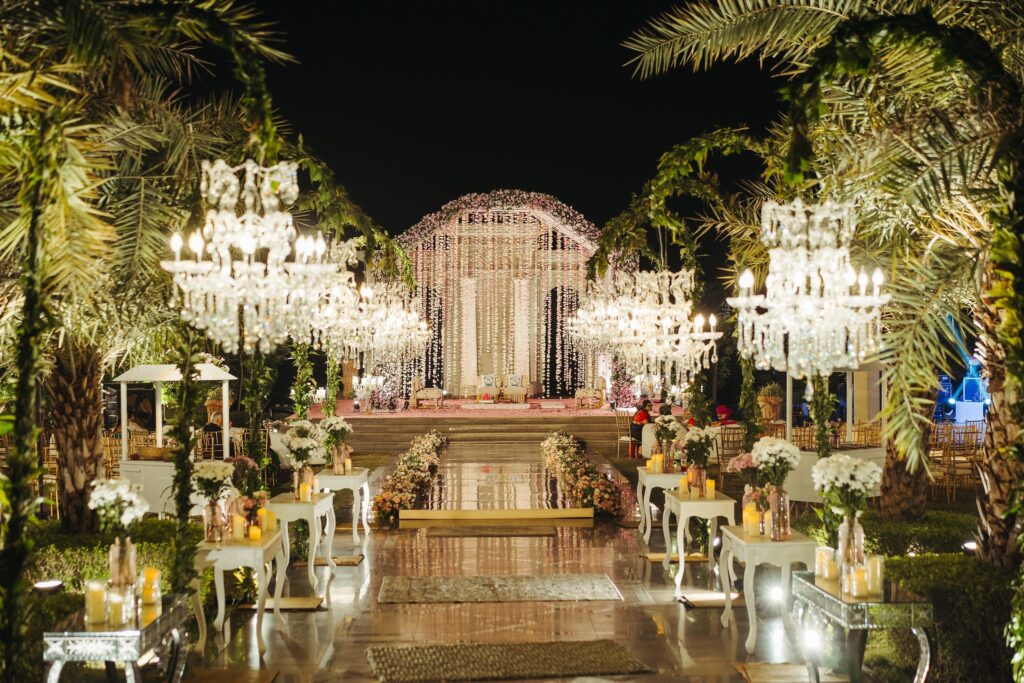
Rituals are the emotional centre of an Indian wedding. They are also the part most likely to throw your entire day off track, not because anyone is careless, but because rituals run on people, materials, tradition, and timing that does not behave like a neat event schedule.
The couples who ask us about wedding planning and management usually want the same outcome: a ceremony that feels serene and meaningful, and a day that stays on time without anyone feeling rushed. The way to get there is simple in concept and detailed in execution: you build the wedding timeline around the rituals, not around the reception.
At The Wedding Trunk (established in 2017, planning across India and the UAE, with 50+ celebrations delivered), rituals are never treated as a “slot.” They are treated as the anchor that everything else supports. If you want us to map your ritual flow and build a realistic showrun around it, visit www.theweddingtrunk.com or call India: +91 98925 99799 or UAE: +971 56 934 3443.
Start here: build the ritual map before you build the day
The first mistake families make is planning the day from the outside in. Makeup timings. Photo timings. Reception entries. Dinner. And then rituals are squeezed into whatever space is left.
Instead, start with a ritual map. Not a poetic description, a working document that answers:
- What rituals are happening (and which ones are non-negotiable)?
- Who must be present for each ritual (couple, parents, siblings, maternal side, priest)?
- What is required physically (mandap setup, seating, fire setup if applicable, ceremony materials)?
- What constraints exist (muhurat windows, venue rules, travel between locations, heat, sound restrictions)?
- Where do you want quiet moments, and where do you want energy?
This is ritual management in its truest form. Once this map is clear, wedding planning and management becomes easier because every other department can plan around something stable.
If your families have different expectations around rituals and timing, it helps to settle the ritual map early with one clear approval. www.theweddingtrunk.com
What can go wrong when rituals are “assumed”
Rituals rarely “go wrong” in a dramatic way. They unravel through small gaps that create delay and stress. These are the most common ones we see in India and the UAE:
1) The priest arrives, but the setup is not ready
The mandap looks beautiful in photos, but the practical pieces are missing: seating is tight, the havan space is unsafe, the ceremony table is not set, or the required items are not organised.
2) Ceremony materials are incomplete or scattered
Samagri is not one bag. It is a system. When it is scattered across rooms or arriving late, the ritual slows down while someone searches, calls, and runs.
3) Key family members are not in place
Parents are taking calls, a sibling is stuck in traffic, and the elders are still getting ready. The priest waits, the couple waits, guests sit and start checking phones. The ceremony begins already feeling delayed.
4) The photo and video team pulls the couple away at the wrong time
Not because they are wrong, but because the timeline did not define protected ritual windows versus flexible photo windows. The couple gets rushed, the priest gets impatient, the day gets tense.
5) A late baraat or late guest movement compresses the ceremony
When arrivals are not managed, everything downstream suffers. This is why RSVP, guest communication, and hospitality planning matter even for the ritual timeline.
A strong wedding planning and management system prevents these issues before the wedding week begins.
How professionals prevent delays without disturbing the meaning
Here is the behind-the-scenes structure that keeps rituals calm and on time, without turning them into a performance.
Step 1: Create a ritual-first run sheet, not a generic schedule
The schedule says, “Ceremony: 4 pm.” A run sheet says what must be ready by 3:15, who must be seated by 3:40, and which moments must never be interrupted.
A ritual-first run sheet includes:
- ceremony readiness checks (mandap, seating, materials, safety)
- priest call time and briefing window
- family sequencing (who is where, when)
- protected ritual blocks versus flexible blocks
- buffers for real human pace
This is where show-running begins. The aim is not to control tradition. It is to protect it from chaos.
Step 2: Assign ownership of readiness, not just aesthetics
Someone must own ritual readiness on the ground. Not the decor team, not the family, not the priest. A designated planner-led lead checks:
- mandap practicality (comfort, visibility, movement)
- samagri organisation (grouped in ritual order, not dumped in one place)
- microphones and sound placement (if used)
- seating for elders and immediate family
- water, shade, and comfort details
When readiness is owned, rituals feel unhurried.
Step 3: Build parallel tracks so the couple is never the bottleneck
The biggest reason couples feel rushed is that everything depends on them being in the right place at the right time, with no buffer.
We build parallel tracks:
- one track for rituals
- one track for couple preparation and movement
- one track for guest seating and arrivals
- one track for photography positioning and lighting checks
This is where shadows and personal assistance matter. A trained shadow does not “hurry” the couple. They quietly keep movement smooth, coordinate family entries, handle small issues, and protect the couple from constant questions.
If you want your ceremony to feel emotionally present instead of operationally hectic, call India: +91 98925 99799 or UAE: +971 56 934 3443.
Step 4: Coordinate vendors around ritual boundaries
Ritual timing collapses when vendors operate independently.
Vendor selection and management, in the context of rituals, means:
- photographer knows which ritual moments are non-negotiable and cannot be paused
- production team knows sound and mic needs in advance
- decor team understands practical requirements, not just design
- hospitality team knows when guest movement must pause so the ceremony can begin cleanly
When vendors are aligned early, you stop paying for last-minute changes and overtime.
Step 5: Align food and guest energy to the ritual flow
In multi-day weddings, guests arrive at rituals with different energy levels. Some have travelled, some are jet-lagged, elders need comfort, kids need pacing.
F and B management helps the ritual timeline more than people expect. Light refreshments placed at the right moments, water availability, and a sensible post-ceremony flow prevents guests from drifting away exactly when you need them present.
India and UAE: what changes in ritual timeline planning
The emotional needs stay the same. The operational environment changes.
In India, common timeline pressure points include:
- traffic variability and longer movement time between venues
- larger family groups arriving in waves
- outdoor heat or sudden weather changes in certain seasons
In the UAE, pressure points often include:
- stricter venue access windows and tighter operational rules
- more international guests who rely heavily on clear instructions
- high expectations for punctuality and smooth flow
This is why destination and venue selection matters for rituals. A venue that looks perfect but makes ritual setup complicated will cost you time, money, and calm.
If you want help choosing a venue in the UAE that supports Indian ritual flow comfortably, talk to us at www.theweddingtrunk.com.
A sample ritual-first timeline skeleton
Every wedding is different, but a strong structure often looks like this:
- Guest arrival window opens (with clear seating guidance and comfort planning)
- Family and couple positioning (quiet, private, not in full guest view)
- Priest briefing and readiness check (materials, mic, sequence)
- Ritual block begins (protected time, minimal interruptions)
- Flexible window after key rituals (photos, blessings, guest greetings)
- Transition buffer (couple reset, mandap clear, guest movement)
- Next segment begins (cocktails, dinner, reception flow)
Notice what is missing: rigid minute-by-minute pressure. The timeline is designed to hold its shape even when real life happens.
A checklist you can copy before you finalise your plan
Use this to judge whether your wedding planning and management is ritual-ready:
- Ritual map is approved by both families (what is included, what is not)
- Priest is confirmed with call time and a briefed sequence
- Samagri is organised in ritual order and assigned to one owner
- Mandap setup is checked for practicality and comfort, not only looks
- Family sequencing is mapped (who must be where, and when)
- Photography team understands protected ritual windows
- Guest arrivals and seating are planned with clear guidance
- Buffers exist before the ritual start and before the next transition
- Couple has trained support so they are not interrupted constantly
When rituals are planned properly, they feel calmer. Not shorter, not rushed, calmer. The family is present instead of managing. The couple experiences the ceremony instead of chasing it. Guests feel the difference immediately.
If you are planning a wedding in India or the UAE and want a ritual-first timeline that holds with quiet confidence, The Wedding Trunk can guide you from the first budget conversation to full on-ground execution.