
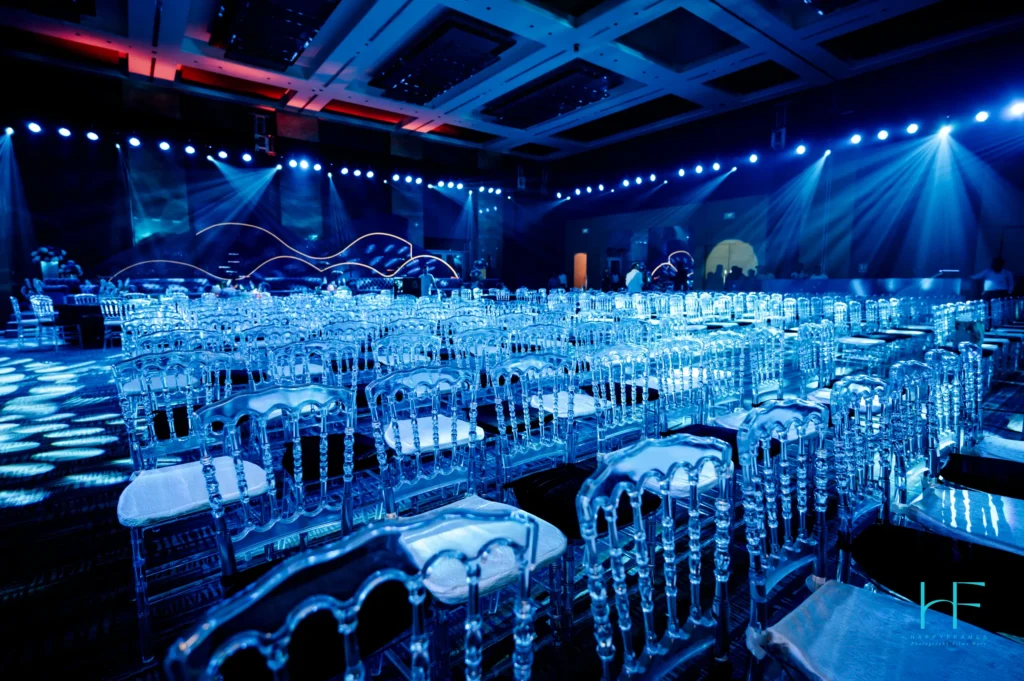
At 4:42 PM, the ballroom looks finished. Guests are arriving. Music is soft. The mandap is glowing exactly the way it should.
Backstage, it feels different.
A production headset crackles. The stage LED is on the wrong file. The groom’s side is five minutes behind on transfers. The priest is asking for one more item. The photographer needs the couple to hold for sixty seconds because the light just shifted. The hotel is calling about two rooms that were swapped last night.
None of this is a disaster. It’s a wedding. It’s live.
And this is why destination wedding planning needs a control room. Not a physical room with screens, necessarily. A working system where every moving part has an owner, every decision has a path, and the couple never becomes the help desk.
At The Wedding Trunk (established in 2017, planning across India and the UAE), we plan weddings end-to-end from “they said yes” to “thank you for coming,” including show-running, vendor management, RSVP systems, hospitality desks, logistics planning, rituals readiness, and on-ground execution. If you want your wedding weekend to run with calm control behind the scenes, visit www.theweddingtrunk.com or call India: +91 98925 99799 or UAE: +971 56 934 3443.
What the control room really is
It’s not a drama. It’s structure.
Live event coordination is the difference between:
- vendors working together versus vendors colliding
- guests feeling guided versus guests feeling confused
- a couple being present versus a couple constantly being asked
In destination wedding planning, especially across India and the UAE, the control room system usually includes three layers:
- one showrunner making timing calls
- department leads owning their zones
- a clean communication chain so questions do not bounce around
When it works, guests never notice it exists. They just feel that the wedding is smooth.
A quick, simple note on venue recce and why it matters
A venue recce is when you go to the location in advance to check everything properly, instead of assuming it will work on the day. For a wedding, venue recce includes checking the space layout (stage, seating, entry and exit), understanding lighting and decor possibilities, looking at power supply, sound setup and AC, planning camera angles and photography spots, identifying guest flow and parking, and spotting any problems in advance. In simple terms, recce is how you plan smoothly and avoid last-minute issues that create delays and stress.
A strong control room relies on recce because it turns guesses into facts. Entrances, bottlenecks, power points, sound limitations, and real walking routes become known early. That is what makes day-of decisions faster and calmer.
The people inside the system
A calm wedding weekend is not run by one person doing everything. It’s run by the right people owning the right parts.
The showrunner
This is the primary decision-maker on the day. The showrunner owns:
- the master run sheet
- the order of moments and cues
- real-time adjustments when something shifts
- protecting anchors like dinner timing and ceremony start calm
The showrunner does not ask the couple for every decision. They run the day within pre-agreed boundaries.
The hospitality lead
This is who makes guests feel handled. They own:
- the guest support number
- hotel liaison and check-in issues
- guest questions that would otherwise reach parents
- on-ground help for elders and overseas guests
The logistics lead
This is who protects time. They own:
- airport pickups in waves
- transfers between venues
- catch-up plans for delays
- return waves for early, main, and late groups
The production lead
This is who makes the night feel professional. They own:
- sound checks and mic control
- lighting cues and face light
- screens and playback files
- technical readiness before doors open
The decor lead
This is who ensures the room looks finished when guests arrive. They own:
- styling completion time
- clutter removal and clean frames
- last-minute fixes that are invisible
- handover points to production and photography
In The Wedding Trunk’s style of destination wedding planning, these roles sit under one umbrella, so vendors are not running on separate assumptions. If you want this structure built for your wedding weekend, start at www.theweddingtrunk.com.
What the control room tracks in real time
Most people assume coordination is about “keeping time.” Time is only one part. The control room is constantly tracking:
1) Guest readiness
Are guests arriving in the right window, or are half still on the road? Are elders seated comfortably? Is the late-arrival entry plan active?
2) Room readiness
Is the room photo-ready? Are chairs aligned? Are aisles clear? Is the mandap or stage clean from all angles?
3) Technical readiness
Are microphones tested for speech clarity, not just music volume? Is the entry track cued? Is the correct screen content loaded?
4) Couple readiness
Is the couple hydrated, touched up, and protected from questions? Are outfit changes timed during low-attention windows?
5) Ritual readiness
Is the priest briefed? Is samagri staged and owned by one person? Are key family members in place before the ritual begins?
When these five are aligned, the day feels effortless.
How decisions actually happen during live coordination
The strongest weddings have a simple rule: decisions move up only when they need to.
Here’s what that looks like on the day:
- A coordinator spots an issue, like a seating bottleneck.
- They escalate to the department lead, like hospitality or decor.
- If it impacts timing, the showrunner makes the call.
- If it impacts a cultural non-negotiable, it goes to the family decision.
- The couple is informed only if it affects a personal moment.
This is why the control room matters. Without it, every question goes sideways, lands on parents, and then eventually reaches the couple.
If you want a wedding where vendors do not call the couple directly on event days, call UAE: +971 56 934 3443.
The handover points that stop chaos
Most wedding delays are not caused by one big problem. They’re caused by vendors colliding.
A control room runs on handover points, like:
- decor hands over the space to production at a fixed time
- production locks sound and lighting before photography positions are finalised
- catering confirms counters open and staff ready before the showrunner cues the room
- doors open only when the room is truly finished
This is how a venue feels calm when guests enter. No visible fixing. No ladders. No cables being dragged through the aisle.
It also protects budgets, because overtime is often triggered by late setups and unclear handovers.
The calm communication rule guests never notice
In destination wedding planning, communication can either be a luxury or a mess.
The control room keeps it clean with three channels:
- one vendor channel for cues and operational questions
- one small approvals channel for family decision leads
- one guest support number for all guest queries
Guests do not message the couple for transfers. Vendors do not call parents for technical decisions. Everything routes through one point of contact.
If you want guest communication handled like concierge guidance, not group chat noise, reach us at www.theweddingtrunk.com.
The moments the control room protects the most
If you’re wondering where live coordination matters most, it’s usually these moments:
The check-in and arrival wave
This is where guests decide whether the weekend feels hosted. When room lists are controlled and a hospitality desk is active, the family stays calm.
The first five minutes of every event
If the opening is smooth, the room trusts the night. If the opening is late and messy, the room becomes impatient.
Dinner timing
Hungry guests lose patience quickly. A disciplined control room protects meal anchors so the evening doesn’t drag.
The couple’s entry and key rituals
These are emotional moments. They should not be interrupted by tech fixes, guest movement, or vendor questions.
The transition to party
A premium party shift is clean. Lighting changes, music rises, service continues quietly, and guests flow without confusion.
Copy-ready checklist: what the wedding control room runs on
- One showrunner owns the master run sheet and timing calls
- Department leads assigned: hospitality, logistics, production, decor, rituals, F and B
- One guest support number active so parents are not the help desk
- Transfers planned in waves with a catch-up option
- Entry and seating flow guided with on-ground marshals
- Sound checks protected for speech clarity and key cues
- Rooms go photo-ready before doors open, with a final readiness sweep
- Handover points set so vendors do not collide
- Decision ladder clear so small issues do not reach the couple
- Venue recce completed early so entrances, power, routes, and constraints are known
A wedding feels luxurious when it feels held.
Guests are guided without being managed. Parents are present instead of operational. Vendors execute without mixed instructions. Timelines hold without rushing sacred moments. And the couple gets to actually live the weekend they planned.
That is what the wedding control room is doing during live event coordination. Quietly. Constantly. Professionally.If you want The Wedding Trunk to build and run this system as part of your destination wedding planning across India and the UAE, we’re here: www.theweddingtrunk.com | India: +91 98925 99799 | UAE: +971 56 934 3443.