
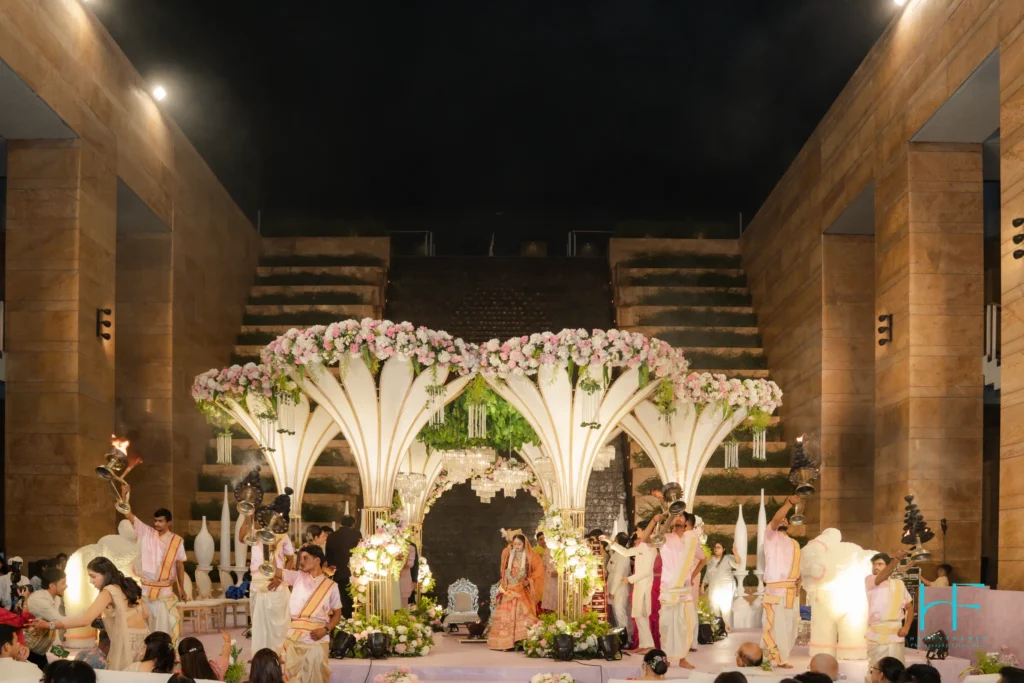
Multi-day weddings look effortless when you are living them from the guest side. You float from one beautiful moment to the next. You never see the van that arrived early so the mandap could be reset quietly. You never hear the vendor calls that happen before sunrise. You never realise that the couple’s entry was moved by eight minutes so a delayed transfer did not derail the entire night.
That is what strong luxury event management looks like in 2026. Not a packed itinerary. A timeline that protects the feeling of the celebration, even when real life tries to interfere.
At The Wedding Trunk (established in 2017, planning across India and the UAE), we have learned that the only timelines that work are the ones built around people and flow, not just rituals and decor. Multi-day celebrations need space to breathe, clear decision points, and a team that can run parallel operations without pulling the families into the control room.
If you are planning a wedding that spans multiple days and cities or involves guest travel, you can speak to us at www.theweddingtrunk.com or call India: +91 98925 99799 or UAE: +971 56 934 3443.
The six timeline problems that quietly ruin multi-day weddings (and how to fix them)
1) The schedule is “perfect” on paper but impossible in real life
Most wedding timelines fail because they ignore the invisible minutes: traffic within a property, elevators, guest greetings, outfit changes, photographer buffers, elders moving slowly, or simple human fatigue.
What works instead is a priorities-first timeline. We begin with client meetings and budget setting, but we also set emotional priorities: what must feel unhurried, what moments matter most to the families, and where we can simplify without anyone noticing.
A working multi-day timeline usually includes:
- shorter core function windows, with intentional “open” time around them
- built-in buffers before entrances, rituals, and performances
- realistic travel and reset blocks between events
A luxury timeline does not chase perfection. It protects pace.
Soft note: If you want us to map your days in a way that feels calm, not cramped, start with a planning call via www.theweddingtrunk.com.
2) Guest arrivals create chaos across day one and day two
For travel-heavy weddings, the first 24 hours decide the tone. If guests land confused, tired, and unsupported, the wedding begins with stress.
This is where RSVP and guest list management and hospitality coordination become the backbone, not an add-on. In 2026, we run guest communication like a system: confirmations, room lists, arrival details, and on-event guest query handling so the families are not answering WhatsApp messages during a function.
A timeline that works for guests usually includes:
- a clear arrival window with staggered transfers
- check-in support and a hospitality desk
- a light welcome moment that does not demand full glam or strict punctuality
In India, arrivals can be spread across cities and train or flight timings. In the UAE, arrivals can be more international and sensitive to flight delays and hotel check-in rules. Either way, the fix is the same: plan arrivals like you would plan an event, not like an afterthought.
If your guest list spans multiple cities or countries, call UAE: +971 56 934 3443 or India: +91 98925 99799. We will help you build a travel-proof flow.
3) Vendors are booked, but nobody is managing the handoffs
Multi-day weddings are not one event. They are several events sharing the same people, spaces, and energy. The biggest timeline breakdown happens in the handoffs: when one vendor finishes and another needs to start, with no one managing the gap.
This is why vendor selection and management is not just about choosing talent. It is about coordination discipline across days:
- load-in and load-out windows
- sound checks and technical rehearsals
- makeup schedules aligned to photography, not just the clock
- stage resets that do not interfere with guest movement
When the handoffs are managed properly, the couple feels like the days are carrying them forward. When they are not, you feel every pause.
4) The couple and families become the coordination team
A timeline can look fine until the couple is pulled away every ten minutes: “Where should we stand?” “Who is coming now?” “What time is the baraat?” “Can you confirm the artist?”
This is exactly why trained shadows and personal assistance exist. Their job is to protect the couple and immediate families from micro-decisions, keep entries on track, coordinate key people, and handle quick fixes without drama.
On multi-day celebrations, shadows are not a luxury. They are the reason families remain present in the moments that matter.
5) Rituals are respected, but the day still runs late
Rituals deserve care, not rushing. At the same time, multi-day weddings have knock-on effects: a late haldi pushes hair and makeup, which pushes photo time, which pushes the evening event, which pushes dinner, which pushes guest fatigue.
Ritual management is where we balance respect and structure. That means:
- aligning the priest and materials well in advance
- preparing the mandap and ceremony space early enough for calm adjustments
- building a ritual timeline that includes natural pauses and family movement
- planning baraat and pheras readiness so the day does not start late
A working ritual plan is not only spiritual. It is operational.
6) The “big night” is overproduced and under-run
Sangeet, reception, and any performance-led night requires show-running, not only design. In 2026, families want energy without confusion, and artists need clear direction to deliver their best.
Production and show-running covers:
- technical checks and stage timing
- artist management and backstage flow
- controlling the sequence so speeches, performances, and meals do not fight each other
- keeping the room’s energy stable across the night
At a luxury level, this is what separates a beautiful evening from a truly smooth one.
What a timeline that actually works looks like (realistic multi-day flow)
Every wedding is different, but a functional structure often follows this rhythm:
Day 0 (Arrivals and ease-in)
- guests arrive in waves, with transfers and check-in support
- a light welcome touchpoint, not a heavy function
Day 1 (High warmth, low pressure)
- mehendi or intimate gathering in a relaxed time band
- evening that ends at a sensible hour so guests and family recover
Day 2 (Energy day)
- haldi in late morning, with realistic changeover time
- evening sangeet or celebration with proper show-running and food flow
Day 3 (Ceremony day)
- ceremony timed around light, comfort, and elder movement
- baraat and pheras planned with buffers, not wishful minutes
- reception or dinner that prioritises guest experience and smooth transitions
Day 4 (Goodbyes)
- farewell brunch and structured departures
The detail that makes this work is not the labels. It is the spacing, the buffers, and the team that can run operations across venues, hotels, and families without escalating stress.
If you would like us to draft your function-by-function timeline with travel windows and buffers built in, reach us at www.theweddingtrunk.com.
Quick checklist: before you lock any multi-day wedding timeline
Use this before you approve your final schedule:
- Have you built buffers before every entry, ritual, and performance?
- Is there a clear plan for guest arrivals, check-ins, and transfers?
- Do you have one point of contact managing vendor handoffs across days?
- Are hair and makeup timings aligned with photography and travel time?
- Is there a shadow or trained support protecting the couple and key family members?
- Are rituals planned with materials, mandap readiness, and a realistic pace?
- Is the big night show-run with technical checks, artist flow, and sequence control?
- Have you planned for weather or last-minute venue adjustments in India or the UAE?
A calm truth to end on
Multi-day celebrations are not difficult because they are large. They are difficult because they are layered. More people, more movement, more emotion, more opportunities for delays, and more pressure on the family.
The right timeline does not make your wedding feel scheduled. It makes your wedding feel safe.If you are planning across India or the UAE and want a timeline that can handle real life while still feeling premium and personal, speak to The Wedding Trunk team. www.theweddingtrunk.com, India: +91 98925 99799, UAE: +971 56 934 3443. We will help you build days that flow the way they should: with clarity, care, and space to actually enjoy them.