
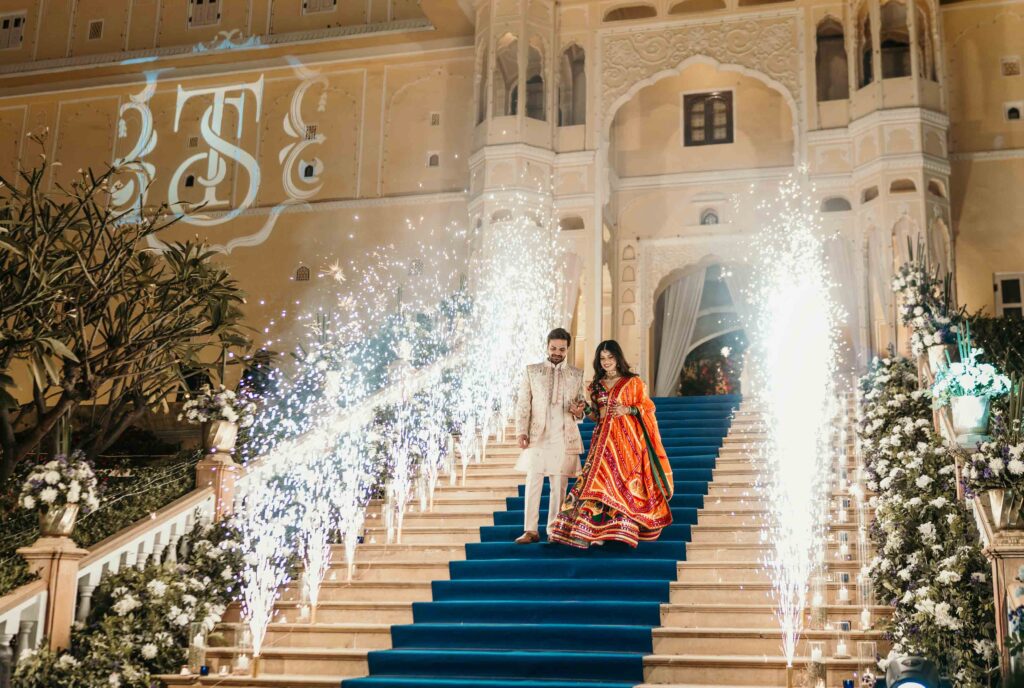
If you need constant announcements to move guests, the problem is not your emcee.
It’s your transition design.
In the best weddings, people flow without being told. They finish a moment, instinctively know where to go next, and arrive at the next space feeling like it was always meant to happen that way. No “Please proceed to…” every ten minutes. No awkward waiting in corridors. No crowding at entrances. No guests stopping the couple’s parents to ask basic questions.
That is luxury event management in real life. Not louder instructions. Better planning.
At The Wedding Trunk (established in 2017, planning across India and the UAE), we plan weddings end-to-end from “they said yes” to “thank you for coming,” including guest operations, hospitality desks, logistics planning, vendor coordination, and on-ground show-running. If you want your wedding weekend to feel effortless for guests, visit www.theweddingtrunk.com or call India: +91 98925 99799 or UAE: +971 56 934 3443.
A quick, simple note on venue recce and why it makes transitions smoother
A venue recce is when you go to the location in advance to check everything properly, instead of assuming it will work on the day. For a wedding, venue recce includes checking the space layout (stage, seating, entry and exit), understanding lighting and decor possibilities, looking at power supply, sound setup and AC, planning camera angles and photography spots, identifying guest flow and parking, and spotting any problems in advance. Venue recce is a pre-visit to plan everything smoothly and avoid last-minute issues. It matters for transitions because you can map real walking routes, identify bottlenecks, confirm which doors should open and close, and decide where signage and staff should stand so movement feels natural.
Why announcements create resistance
Guests don’t ignore announcements because they’re rude. They ignore them because:
- they’re mid-conversation
- they can’t hear clearly
- they don’t know where “there” is
- they don’t want to feel managed
- they’re worried about missing something
So instead of announcing more, you design a system that pulls guests forward.
Think of transitions as choreography:
- what guests see first
- where they naturally walk
- what makes them pause
- what gives them confidence
Now let’s build it.
1) Start with a transition map, not an event list
Most couples plan events. Luxury event management plans movement.
For each transition, write a simple map:
- From where to where (seating area to dining, terrace to ballroom, ceremony to cocktail)
- Who moves first (elders, immediate family, everyone, or only some)
- What guests do while moving (music shift, grazing station, photo moment, lounge)
- Where questions will arise (entrances, washrooms, elevators, drop-off points)
- Who owns the flow (a named coordinator, not “someone from the family”)
When you map transitions early, you stop discovering problems in real time.
If you want us to build a guest flow map across venues in India or the UAE, start at www.theweddingtrunk.com.
2) Use “pull factors” instead of instructions
People move when something attracts them.
Create pull factors that quietly guide guests:
- a warm lighting change in the next area
- live music or a clear music bed that gets slightly louder as you approach
- visible food and drinks already active, not “opening soon”
- a framed entry moment (an arch, floral line, or a clean signage point)
- a staff member greeting and guiding with a simple gesture, not a speech
If guests can see the next chapter is ready, they go willingly. If they can’t see it, they wait and ask questions.
3) Control the doors and sightlines
One of the simplest transition tools is also the most overlooked: doors.
A premium flow often uses:
- one primary door open, other doors closed
- a clear funnel route so guests move in the same direction
- a clean view into the next space so guests feel confident
If multiple doors are open, guests scatter. Scattered guests slow your next moment.
This matters in hotel ballrooms in the UAE and large venues in India where spaces connect through lobbies, corridors, or terraces. Clear sightlines prevent confusion.
4) Build “soft starts” so guests are never waiting in emptiness
Guests hate waiting with nothing to do. That’s when announcements become necessary.
A soft start means the next space is already alive before guests arrive:
- drinks poured
- grazing open
- music playing
- lighting set
- ushers positioned
- seating partially guided
This is how you transition from ceremony to cocktail, or from sangeet to dinner, without telling people where to go.
It also protects your schedule. If the next space begins softly, you can still hold the couple for photos without guests feeling abandoned.
5) Use transition windows, not sharp cutoffs
A sharp cutoff forces announcements. A window reduces them.
Instead of:
- “Dinner starts at 9:00 exactly”
Plan:
- “Dinner opens between 8:45 and 9:10”
- “First dining wave is active while performances are being staged”
- “Elders and families with kids can move earlier”
This removes pressure and stops crowding at one minute. Guests move naturally in waves, and the room stays calm.
If you want timing anchors built around guest comfort, call UAE: +971 56 934 3443.
6) Assign invisible roles on the floor
Smooth transitions are not achieved by one person shouting directions. They’re achieved by quiet staffing.
A clean on-ground structure includes:
- a flow marshal at the transition point (corridor, lift lobby, gate)
- an usher near seating to guide elders and VIPs
- a hospitality desk contact to handle questions without involving family
- a showrunner coordinating cues with production and catering
- a transport coordinator if movement involves cars or shuttles
This is why end-to-end planning matters. Families should not be playing these roles.
If you want a hospitality desk and guest support number active through the weekend, reach us at www.theweddingtrunk.com.
7) Make food service part of the transition design
Food is the strongest pull factor, but only if it’s ready.
Two common failures:
- counters are not open, so guests hover and complain
- buffet layout creates bottlenecks, so movement becomes chaos
A premium approach:
- open a limited set of counters early to start flow
- duplicate high-demand counters to avoid queues
- place water points where they reduce roaming
- create a comfort lane for elders and dietary needs
When the food flow is right, you don’t need announcements. Guests move themselves.
8) Use lighting and music cues like punctuation
Transitions feel elegant when the environment signals change.
Simple cue ideas:
- lighting warms slightly as guests move toward dinner
- a music bed shifts from instrumental to slightly more energetic as the party begins
- speeches happen only after guests are seated and eating
- the party shift is marked by a clear lighting change and a single strong track
Guests don’t need to be told “now we dance.” They feel it.
This is why luxury event management treats production as part of guest flow, not just entertainment.
9) Plan late arrivals and mobility needs into the transition
If late arrivals don’t have a plan, they create noise.
Plan:
- a discreet late-entry route
- ushers who can guide without interrupting key moments
- seating logic that allows quiet entry
- elevator and ramp routes confirmed during recce
- short walking paths for elders, with drop-off points where possible
When these are planned, you avoid the most common form of announcement: emergency guidance.
Copy-ready transition checklist
Use this for every transition in your weekend:
- Transition map written: from, to, who moves first, who owns it
- Pull factor active: lighting, music, food, or a clear entry moment
- Doors controlled: one primary route, clean sightlines
- Soft start ready: next space already alive before guests arrive
- Window approach used: guests move in waves, not at one sharp time
- Floor roles assigned: flow marshal, ushers, hospitality support, showrunner
- Food flow designed: counters open, bottlenecks avoided, water points placed
- Production cues planned: lighting and music shifts mark the new chapter
- Late arrivals and accessibility routes planned and staffed
The best transitions don’t feel like transitions. They feel like the wedding is simply moving forward.
When guest flow is mapped, the next space is ready, cues are designed, and quiet staffing is in place, you don’t need announcements. Guests feel guided without feeling managed. Parents stay present. The couple stays calm. And the whole weekend feels like true luxury event management.
If you want The Wedding Trunk to design and run your guest flow end-to-end across India and the UAE, with hospitality desks, logistics planning, and on-ground show-running, we’re here:
www.theweddingtrunk.com
India: +91 98925 99799
UAE: +971 56 934 3443